Ada and the Partner Problem
AdvancedAges 9–1012 pagesTeamwork
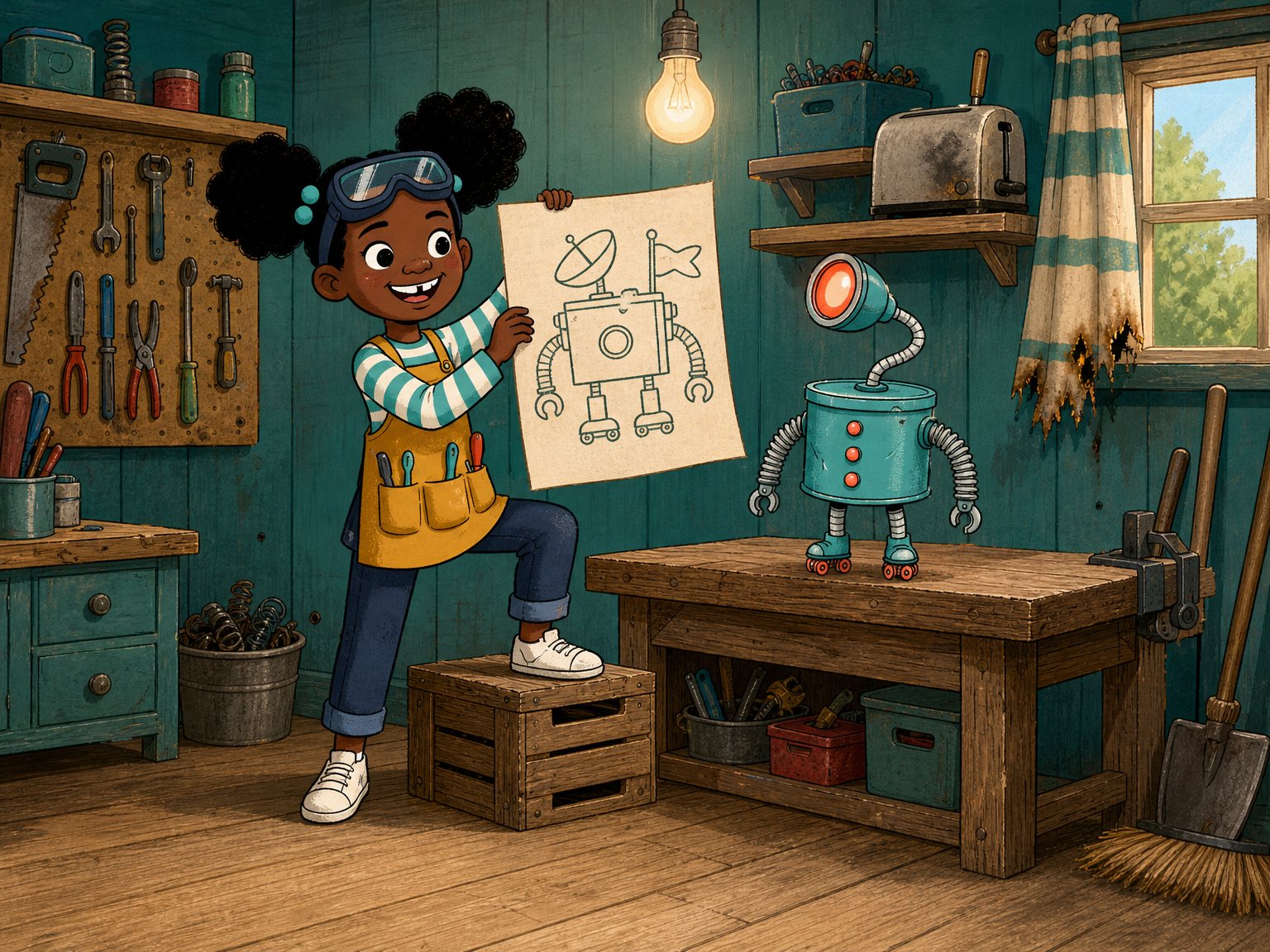
In a garden shed in Saltmarsh, where the jars of screws rattled every time the sea wind blew, Ada drew the best idea she had ever had. 'Weather-Bot,' she announced. 'It reads the wind, the temperature and the air pressure. It crunches the numbers, and it tells you tomorrow's weather before tomorrow has even put its shoes on.' Bolt rolled closer. His lamp eye blinked twice. 'QUERY: WILL IT WORK?' 'Obviously.' The science fair was in two weeks. Ada could build a robot in two weeks. She had once built a toaster that buttered in two days, and it had only set fire to one curtain. 'First prize,' she said, 'is basically mine.' She had not, at this point, heard the word that would ruin everything.
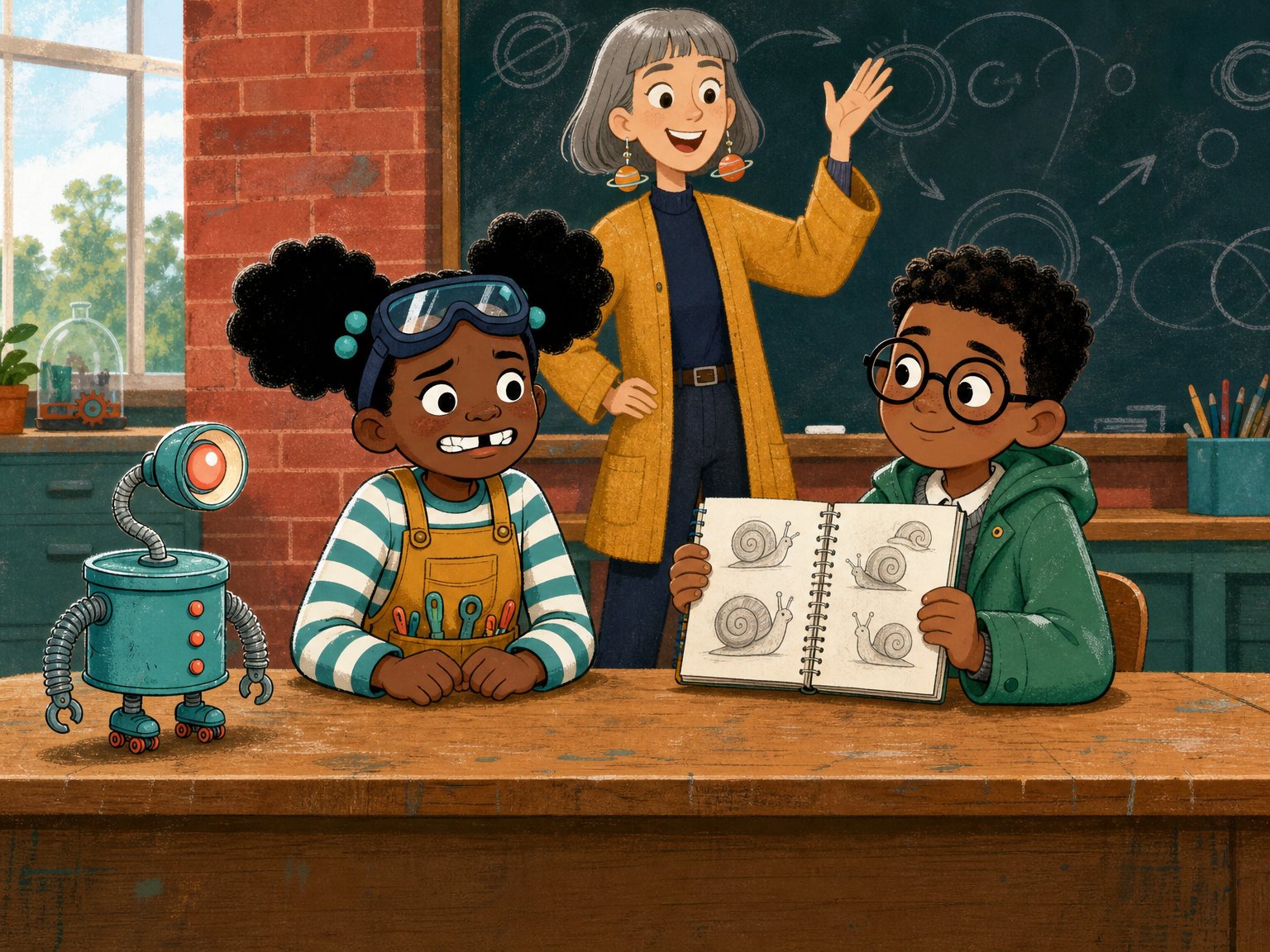
'PAIRS,' said Mrs Pike, and her planet earrings swung like a solar system having a wobble. 'Everyone works with a partner. Science is a team sport.' Science, Ada thought, was not a sport. Sport was slow. 'Ada,' said Mrs Pike, 'you're with Theo.' Theo Marsh was the quietest boy in Year Six. He wore his raincoat indoors. He had once spent an entire wet playtime lying on his stomach by the bike shed, and when Ada asked what he was doing, he said, 'Watching.' Just that. Now he slid into the seat beside her and opened his notebook. Inside were snails. Pages and pages of snails. 'Hello,' he said. 'Hello,' said Ada. 'Great. Fine. I'll handle the robot, and you handle… the rest.' 'What's the rest?' 'Obviously,' said Ada, 'I'll think of something.'
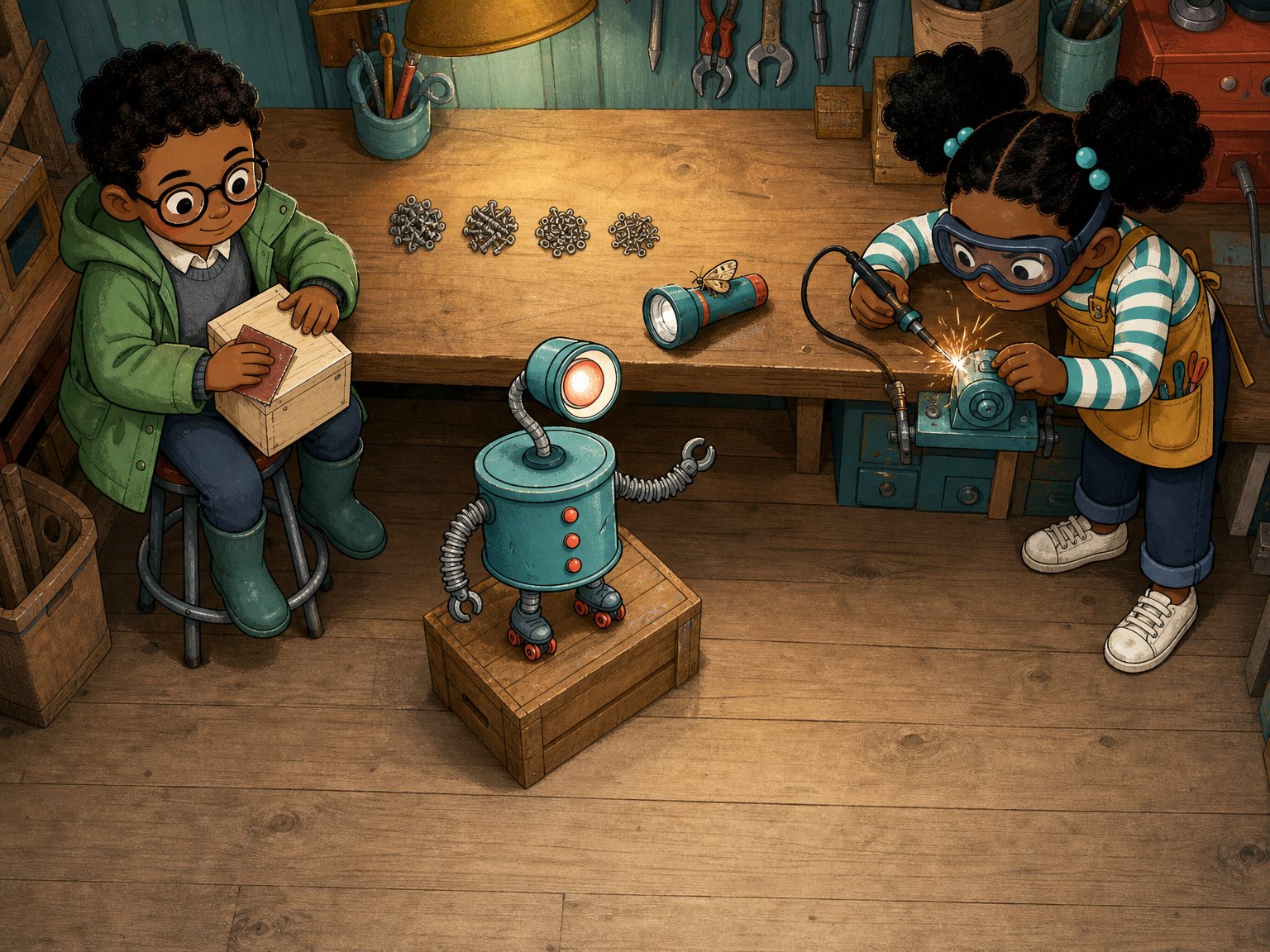
What Ada thought of was jobs. Small ones. Far away from the robot. 'Theo, you're in charge of sorting the screws.' He sorted them by size, then by colour, then by shininess. 'Theo, you're in charge of holding the torch.' He held it so still that a moth landed on it. 'Theo, you're in charge of… the box.' He sanded the box. All afternoon. It became the smoothest box in Saltmarsh. Meanwhile Ada soldered and screwed and hummed at top speed, sparks hopping off her goggles. 'He's very slow,' she whispered to Bolt. 'QUERY: SLOW? HE SORTED THE SCREWS BY SHININESS. I DID NOT KNOW SHININESS WAS A CATEGORY.' Bolt's eye blinked faster. 'I HAVE MADE A NEW FOLDER.' Across the shed, the sanding stopped. Theo put down his sandpaper, looked out of the little window, and opened his mouth.
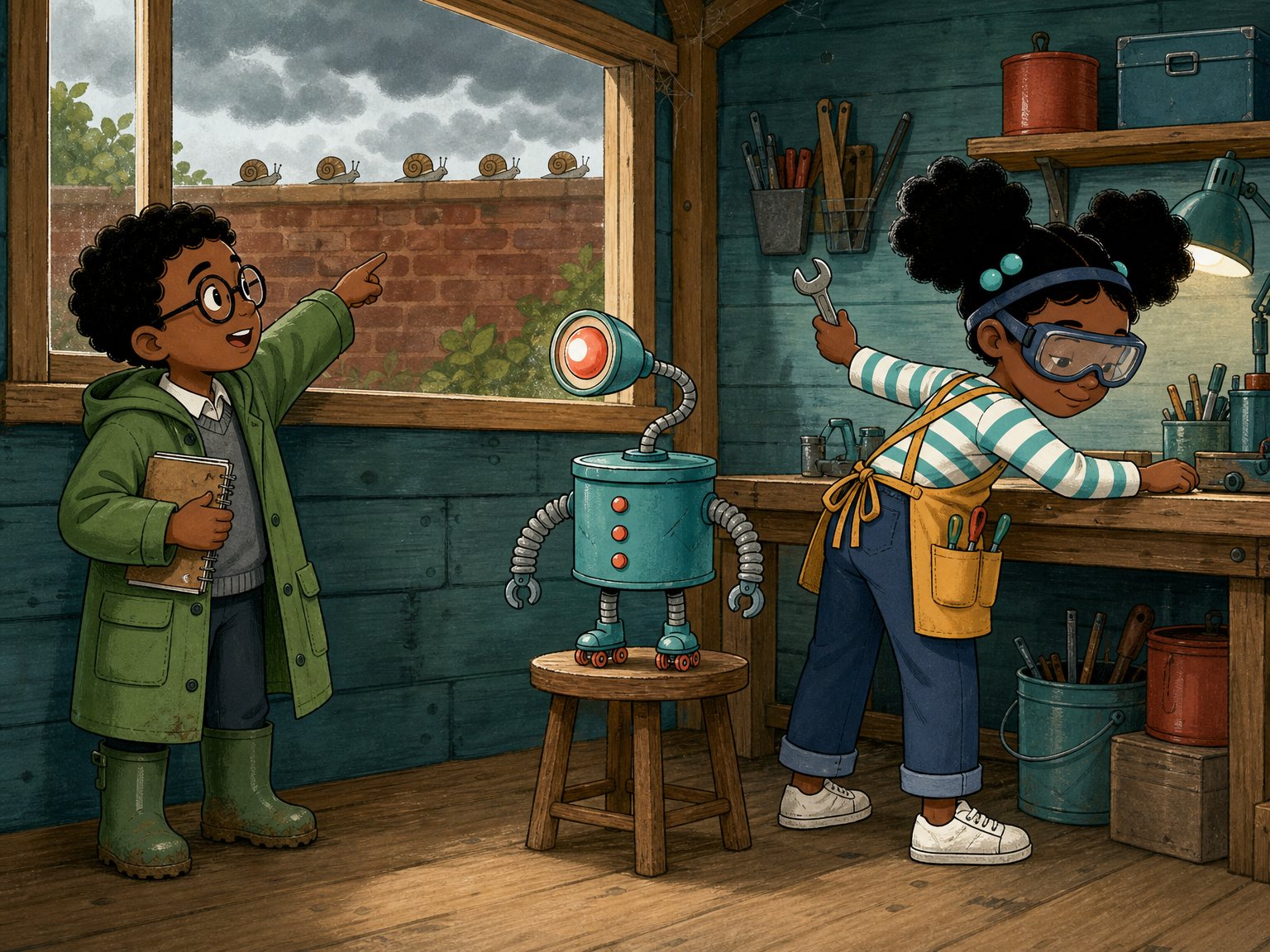
'The snails are up,' said Theo. Ada didn't look up. 'Mm.' 'On the back wall.' It was one long brick wall that ran behind every garden in the terrace, Theo's included. 'When they climb near the top, it usually rains a few hours later. I've been writing it down since half-term.' 'Snails,' said Ada, 'are not science. Science is sensors. Science is data. Science is not a slimy thing going for a wander.' Theo went a bit pink. He closed his notebook the way you'd close a door on a sleeping baby. Ada felt a small, prickly flicker of something. She squashed it with a spanner. But Bolt rolled over, and Theo, who was kind even to biscuit tins, turned the pages one by one under the lamp eye. 'SNAIL DATA: STORED.' At teatime, it rained. Ada was wiring a siren and did not notice. Bolt noticed. 'SNAILS: ONE,' he told nobody. 'WEATHER-BOT: NOT YET CALCULATED.'
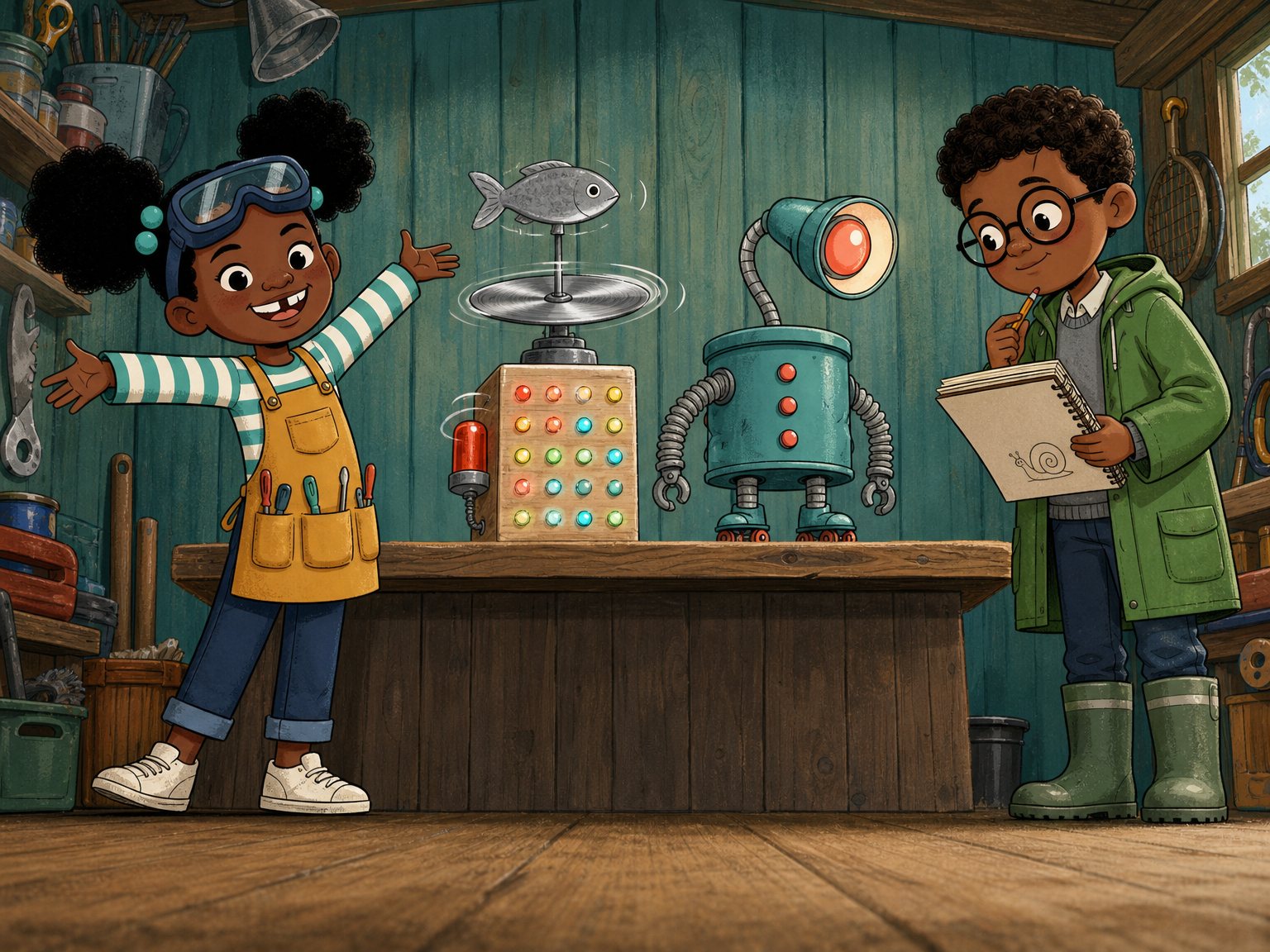
By the end of the first week, Weather-Bot was magnificent. It had a spinning dish. It had a wind vane shaped like a fish. It had seventeen flashing lights, a siren, and a voice Ada had recorded herself, deepened to sound like a newsreader with a cold. 'It takes yesterday's numbers,' she explained to Theo, who had not asked. 'Wind, heat, pressure, the lot. Then it works out tomorrow. Fast.' 'Yesterday's,' said Theo. 'Obviously.' 'So it looks backwards to see forwards?' 'It looks backwards brilliantly.' Theo nodded slowly and drew a snail in the margin. Every afternoon now he spent ten minutes at the wall, and every afternoon Bolt rolled out after him. 'SNAIL DATA: STORED.' Ada called it Bolt's snail phase. On Thursday, in front of all of Year Six, Weather-Bot would make its very first forecast. Ada polished every light twice. She did not check the wall.
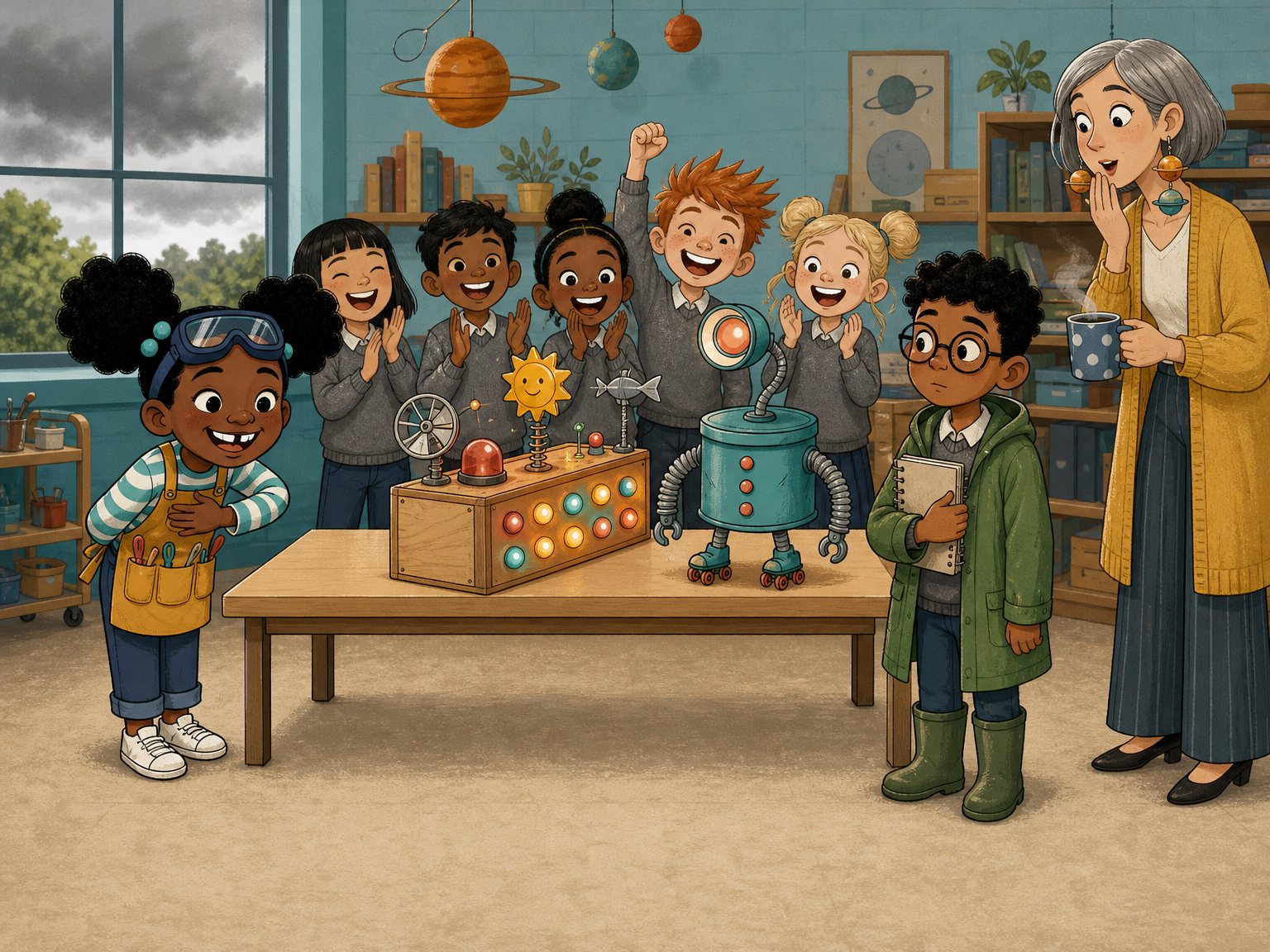
Year Six crowded round the front table. Mrs Pike's earrings were practically orbiting. Ada flicked the switch. Weather-Bot lit up like a fairground. The dish spun. The fish whizzed. The siren whooped so loudly that Mrs Pike's coffee rippled. Then the newsreader-with-a-cold voice boomed: 'TOMORROW: SUNSHINE. ALL DAY. NOT A CLOUD.' A little cardboard sun sprang out of the top on a spring and bobbed. The class actually clapped. Ada bowed. She didn't mean to bow. It just happened. Behind her, very quietly, Theo said, 'The snails on the back wall were halfway up when I left this morning. By tonight they'll be at the top.' 'Theo.' Ada smiled her most patient smile, which was not very patient. 'Weather-Bot has seventeen lights. The snails have none. Tomorrow will be sunny.' She paused. 'Obviously.'
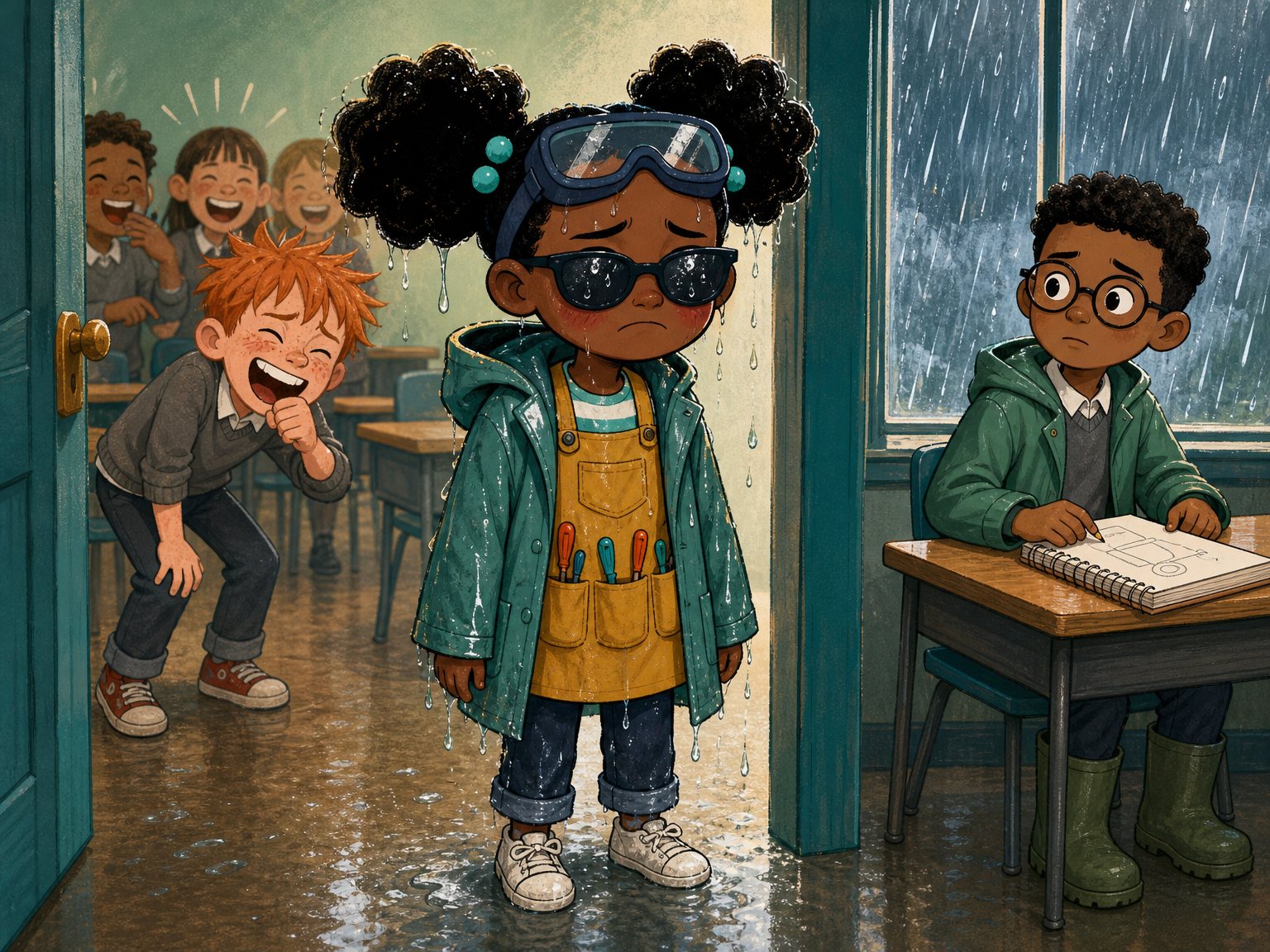
It poured. Not drizzle. Not spitting. The kind of rain that bounces back off the pavement to have a second go at you. And Ada was wearing her sunglasses. She'd put them on at breakfast as a joke for Nan, then shoved them up into her hair when she saw the clock. Hood yanked down to her eyebrows, she sprinted the whole way to beat the bell, seeing nothing but puddles. In the classroom doorway she pushed the hood back, and the sunglasses slid neatly down onto her nose. Somebody noticed. Then everybody noticed. 'Forecast!' boomed Kieran, in a deep, cold-in-the-nose voice. 'SUNSHINE!' The laughter went round the room like a wave round a stadium. Even Mrs Pike's mouth twitched before she straightened it. Ada's face went hot from her chin to her bobbles. She took the sunglasses off, very slowly, and sat down. She didn't say anything at all.
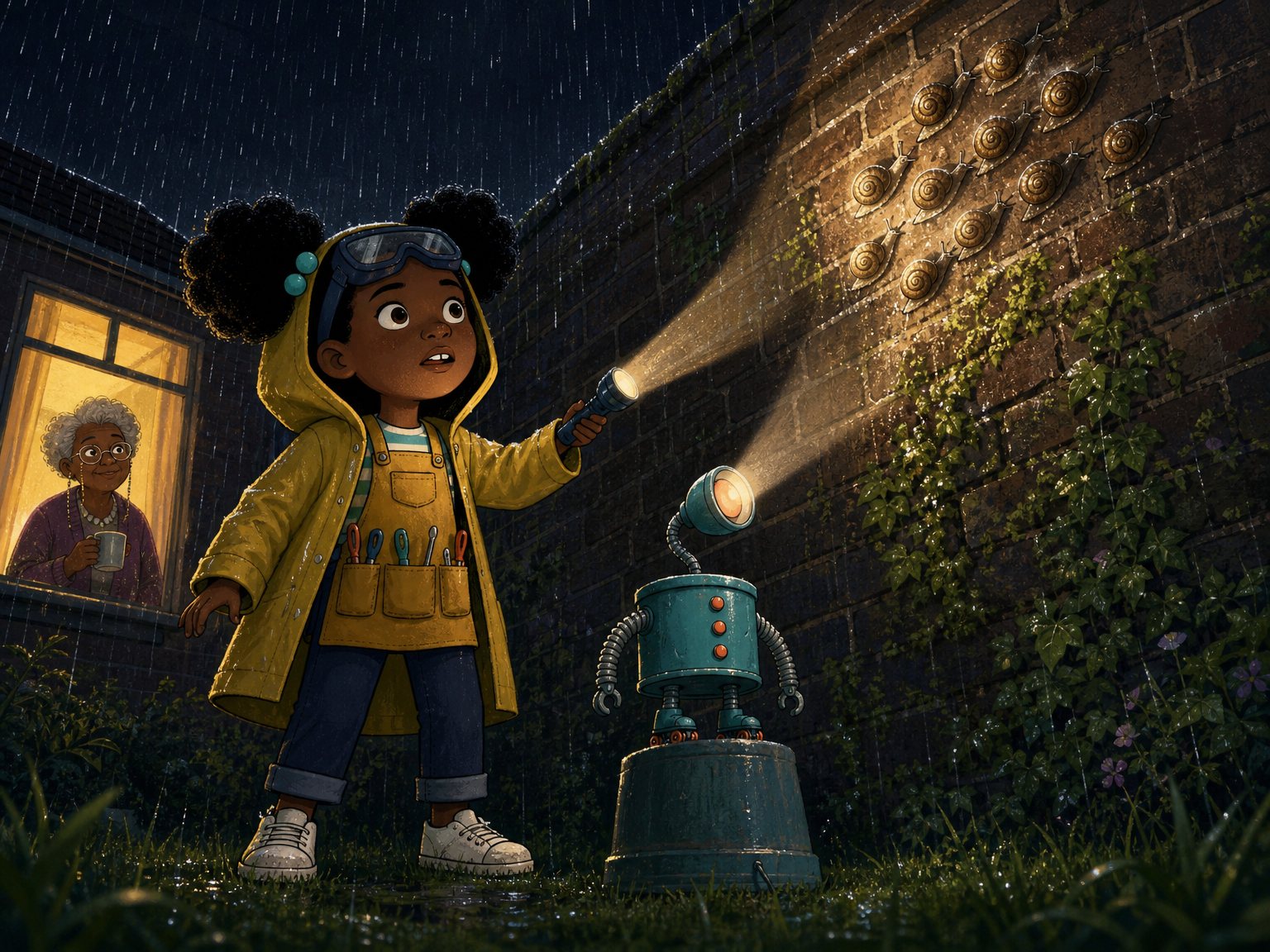
That night, the rain drummed on the roof as if it wanted to come in and laugh at her too. Ada couldn't sleep. Every time she shut her eyes, she saw the cardboard sun bobbing on its spring. She crept downstairs in her coat. Nan was at the kitchen table with a crossword and a cocoa. 'One minute,' said Ada. 'Just checking something.' 'Hood up,' said Nan, and switched the porch light on. Bolt rolled after her, wheels squelching. The torch beam crawled up the wet bricks of the back wall. Past the moss. Past the ivy. Up, and up, almost to the top. Snails. Twelve of them, glistening, perched where the bricks met the sky, exactly where Theo had said they would be. Ada stood in the rain for a long time. 'Bolt,' she said at last, in a voice that didn't sound like hers. 'That snail data. Have you still got it?'
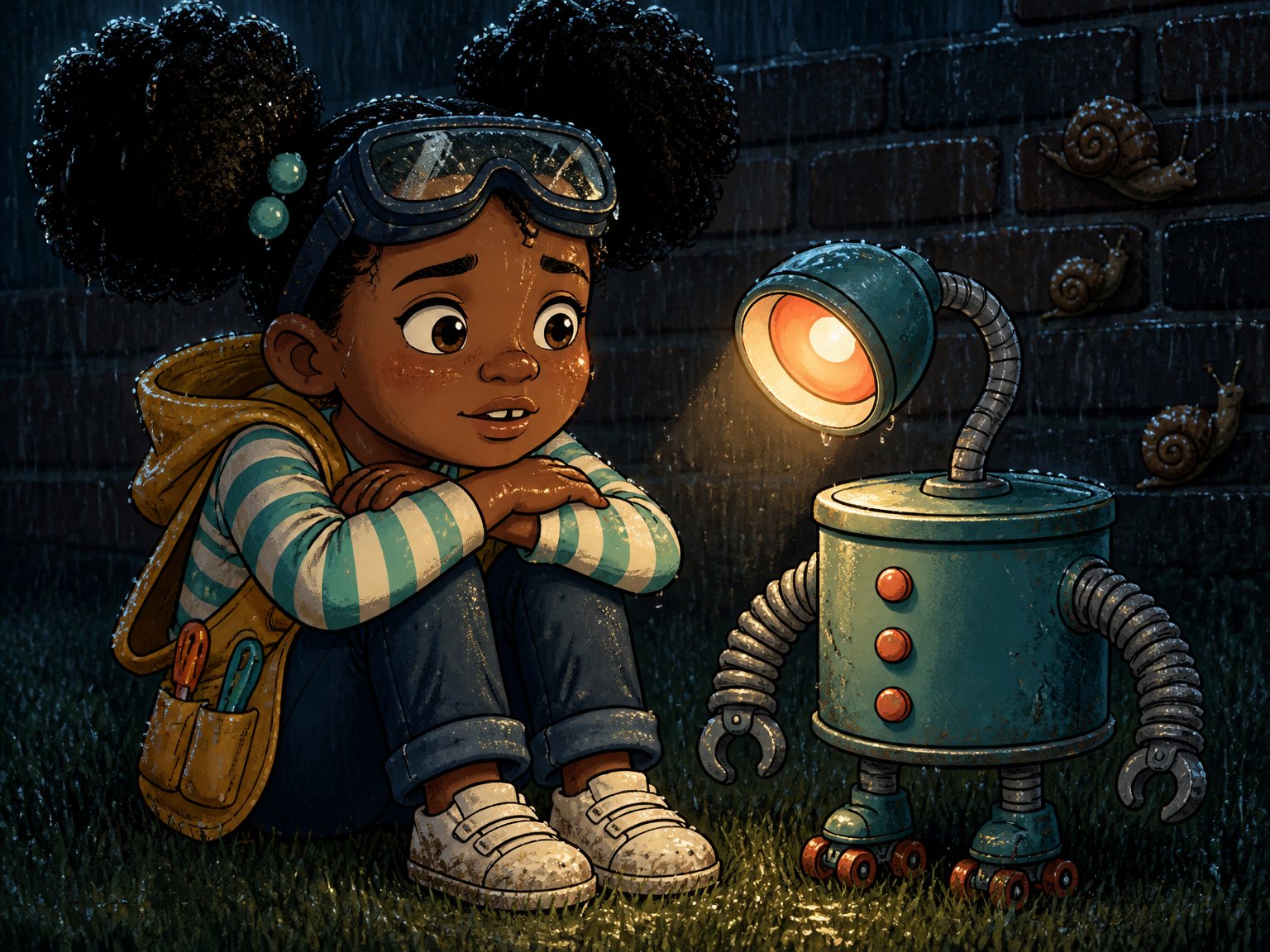
Bolt's eye glowed brighter. His tin body clicked, and in his flat, patient voice, he began. 'TUESDAY. SNAILS HIGH. RAIN AT FOUR. WEDNESDAY. SNAILS LOW. NO RAIN. FRIDAY. SNAILS HIGH. RAIN AT TEATIME.' On and on he went. Every afternoon, Theo had stood at the wall with his pencil while Ada wired her siren. 'SUMMARY. SNAILS HIGH BEFORE RAIN: NINE TIMES OUT OF NINE. WEATHER-BOT: NONE OUT OF ONE.' 'Thank you, Bolt.' 'YOU ARE WELCOME.' Ada sat down on the soggy grass. Weather-Bot had only ever known yesterday. It had spent its whole short life looking backwards, brilliantly. Up on the wall, twelve snails sat in the dark, not boasting about it. Ada stood up. Rain ran off the end of her nose. She knew exactly what she had to do. She just really, really didn't want to do it.
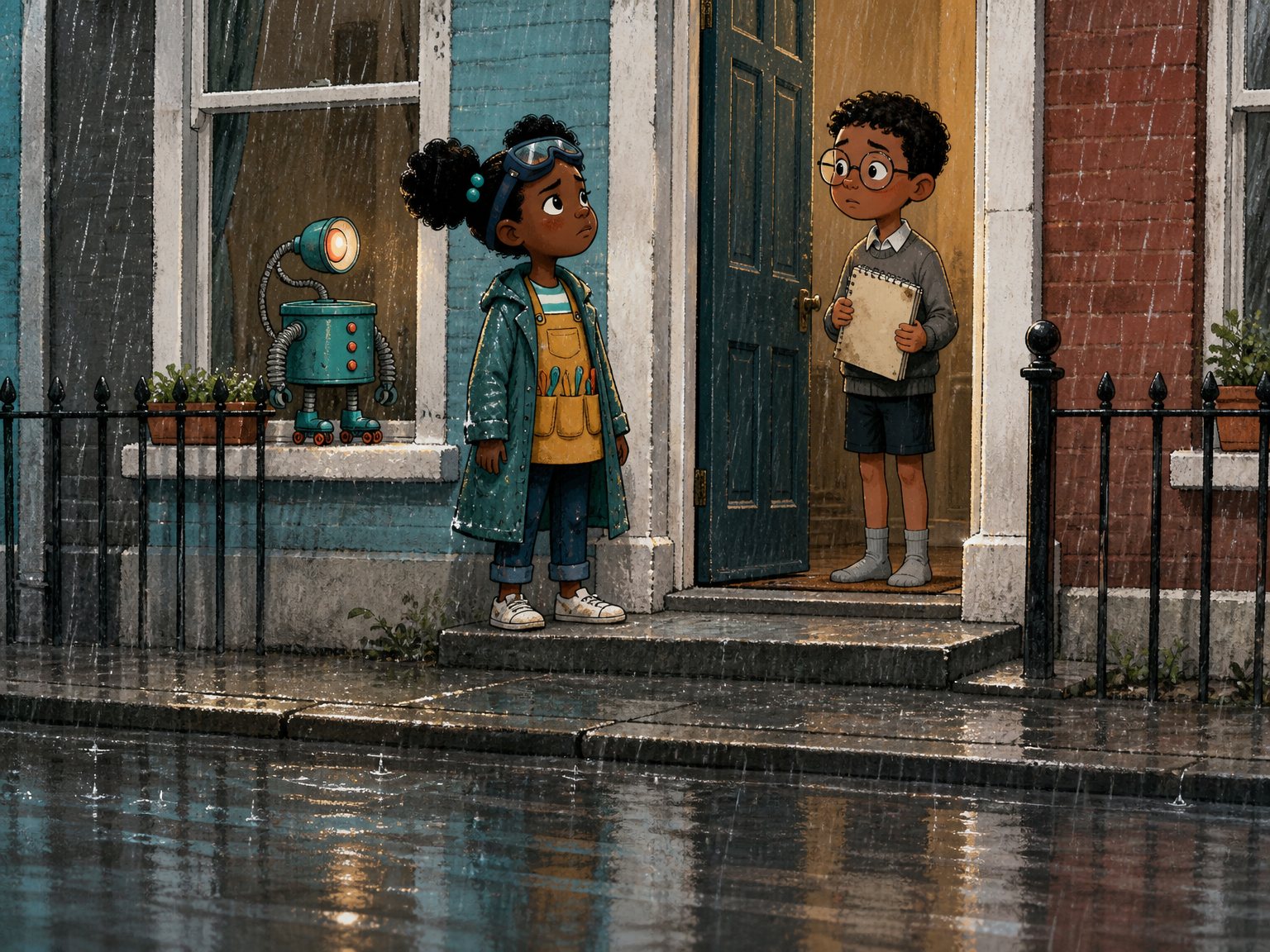
Theo lived three doors down. Ada went the next morning before breakfast, with her coat flapping open, because zips take eleven seconds and she might lose her nerve. She knocked. Water dripped off her bobbles. Theo opened the door in his socks. He looked at her. He looked at the rain. He didn't mention sunglasses, which was somehow worse and better at the same time. Ada had built a toaster that buttered. She had built a robot out of a biscuit tin. These words were the hardest thing she had ever had to put together. 'You were right,' she said. 'I was wrong.' The rain went on raining. 'Will you help me?' Theo pushed his glasses up his nose. Then he stepped back to let her in. 'I'll get you a towel,' he said. 'Then I'll show you the good page.'
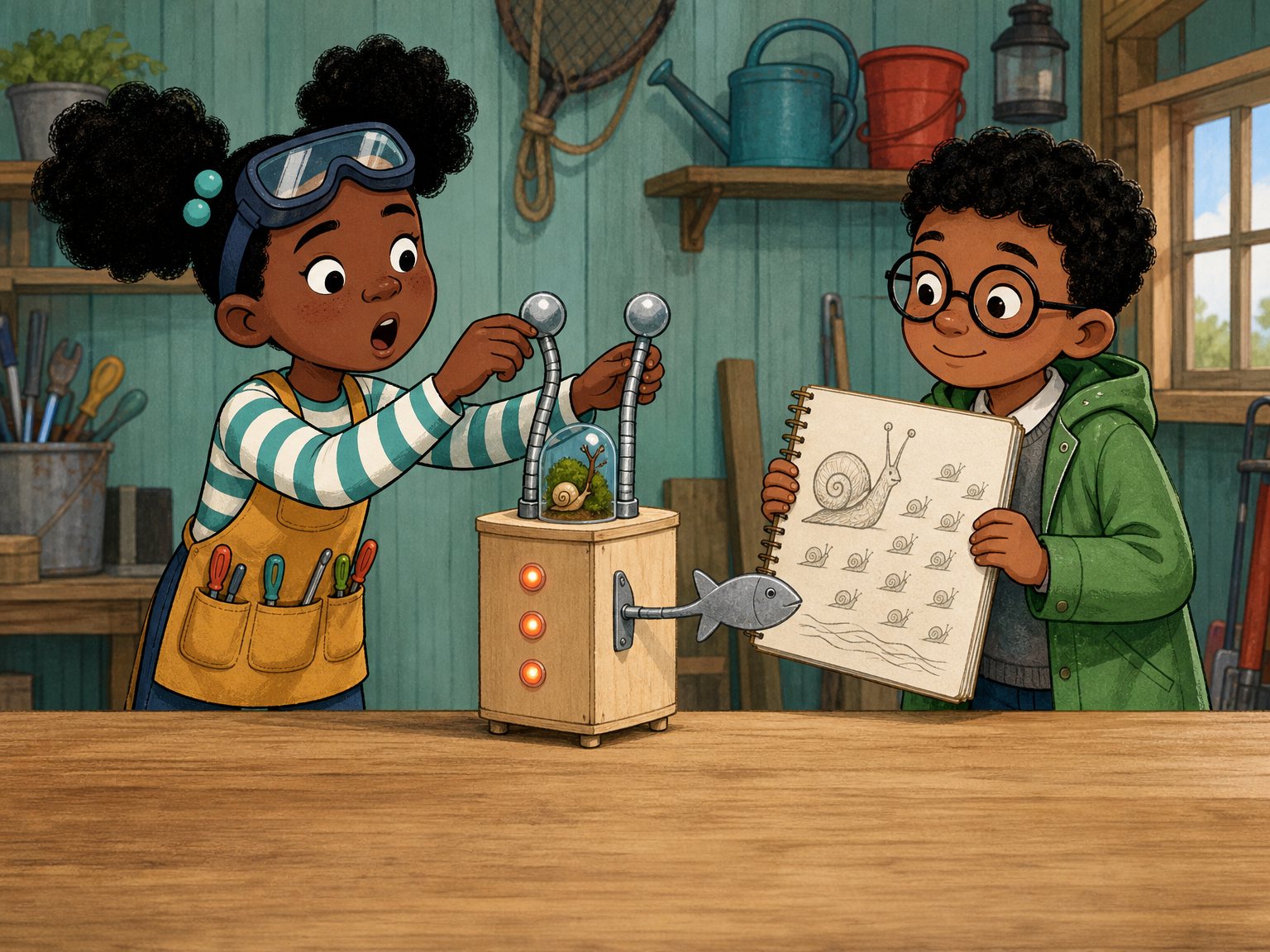
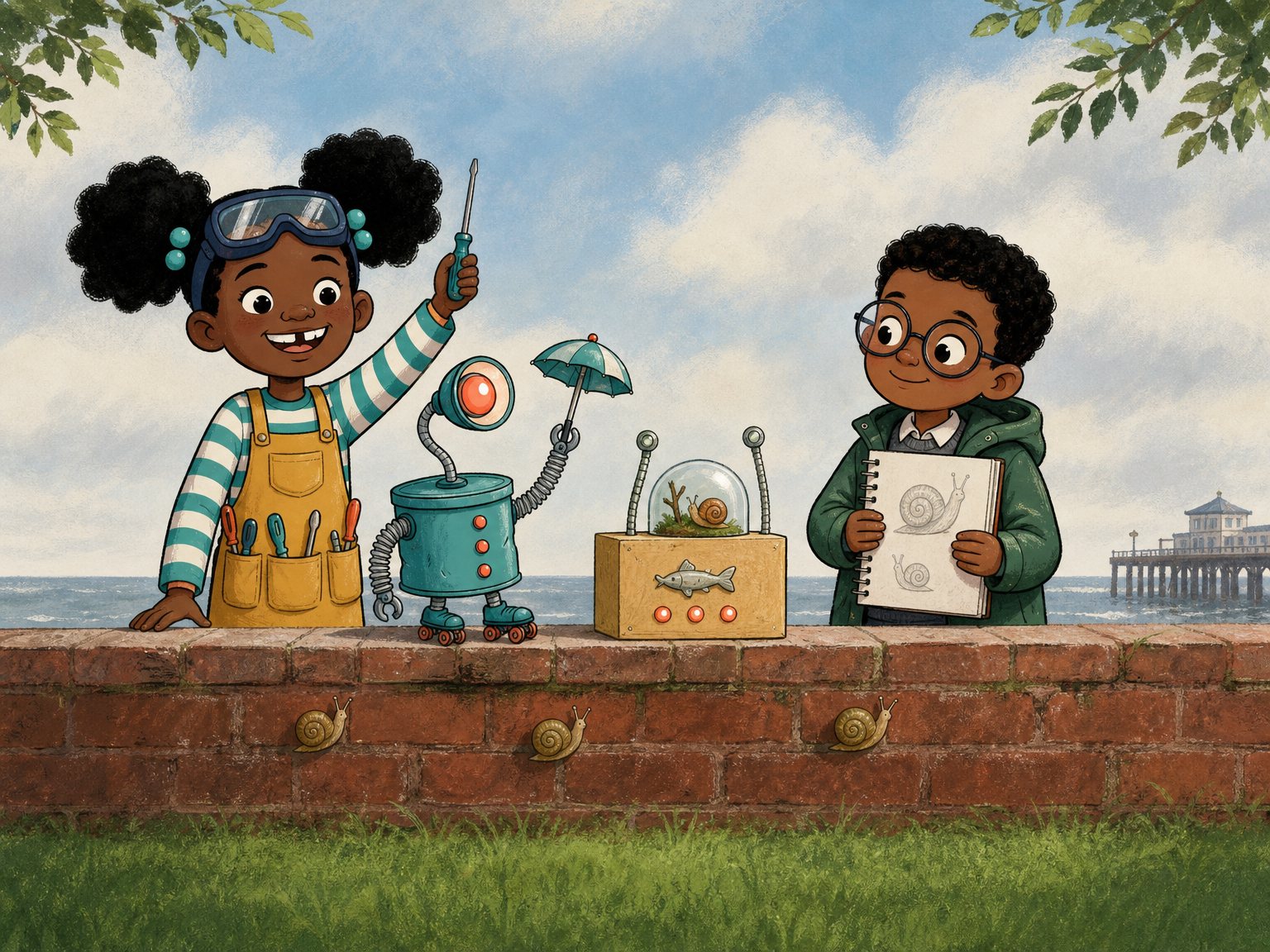
The good page was near the back: one snail, drawn huge, its feelers stretched up like two tiny periscopes. Round the edges were dozens of little ones. 'Before they climb, they do this,' said Theo. 'Testing the air. I think they feel the damp coming. I'm not certain. That's why I keep writing it down.' 'Then Weather-Bot needs feelers,' said Ada, already grabbing wire. Within the hour, it had two bendy damp-air sensors on stalks. 'They're facing the shed,' said Theo. 'Obviously they're facing the—' Ada stopped. On the good page, every little snail faced the same way: towards the sea, where the wet wind came from. She swivelled the stalks round in four seconds flat. They lost the siren and the dish. (Nan was so relieved she made flapjacks.) On top went a little glass dome with one borrowed snail inside. 'QUERY. IS THE SNAIL ON THE TEAM?' 'He's the senior scientist.' Somewhere in Year Six, a volcano was being painted.
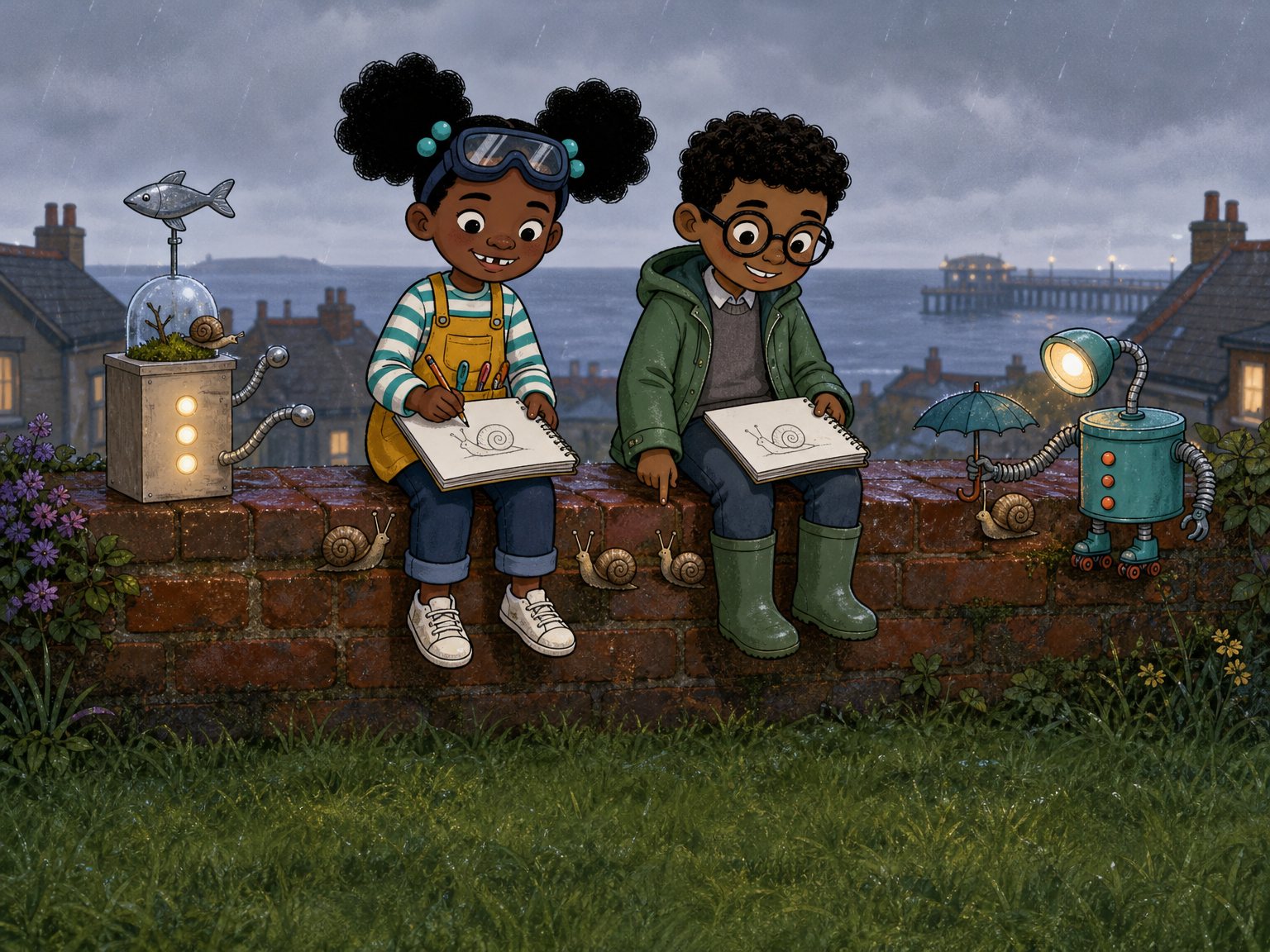
At the science fair, Weather-Bot turned its feelers to the sea and said, in Ada's ordinary voice, 'Tomorrow: probably drizzle. Please check the snail.' The volcano won. Of course it did. But a scientist from the university asked, very politely, to borrow Theo's notebook. Theo went pinker than a prawn. Then she asked Ada if the snail idea was hers. 'Obviously not,' said Ada, grinning. 'I was busy being wrong.' The next evening, it drizzled. Ada and Theo sat on the back wall, notebooks open, watching the snails climb. Nobody said anything for a long, damp, lovely time. 'QUERY,' said Bolt, holding a very small umbrella over a very small snail. 'IS THIS SCIENCE?' Ada looked at the snails. She looked at Theo. Then she wrote something down, slowly and carefully, the way he did. 'Obviously,' she said.
The end
Want a story starring your child?
Tell Bookybara an idea and it paints a brand-new illustrated story around your child’s name, age and reading level — ready before bedtime.
iPhone, iPad & Android · Free to start